What if the most important feature of a DeFi wallet is not the ability to sign faster, but the ability to make a dangerous transaction look suspicious before you approve it? That question explains much of Rabby Wallet’s appeal to users moving between Ethereum, Layer 2 networks, sidechains, and newer EVM-compatible ecosystems. A wallet such as Rabby is not merely a digital container for private keys. It is also an interface for interpreting smart-contract actions, estimating their consequences, and reducing the friction of operating across many networks. For German-speaking DeFi users, that distinction matters: convenience can remove operational mistakes, but it can also encourage people to approve transactions they have not understood.
Rabby emerged as a DeFi-focused, non-custodial alternative to more general-purpose browser wallets, and it was developed by DeBank. Its recent positioning around Ethereum and EVM networks reflects a broader change in the wallet category. In the early period of browser-based crypto, the central problem was connection: could a wallet expose an account to a decentralised application? Today, the harder problem is interpretation. A user may hold assets on Ethereum, Arbitrum, Optimism, Base, Polygon, Avalanche, or the BNB Chain, while interacting with contracts whose names and interfaces are not always intuitive. The useful wallet is therefore becoming a risk-assessment layer, not just a signing window.
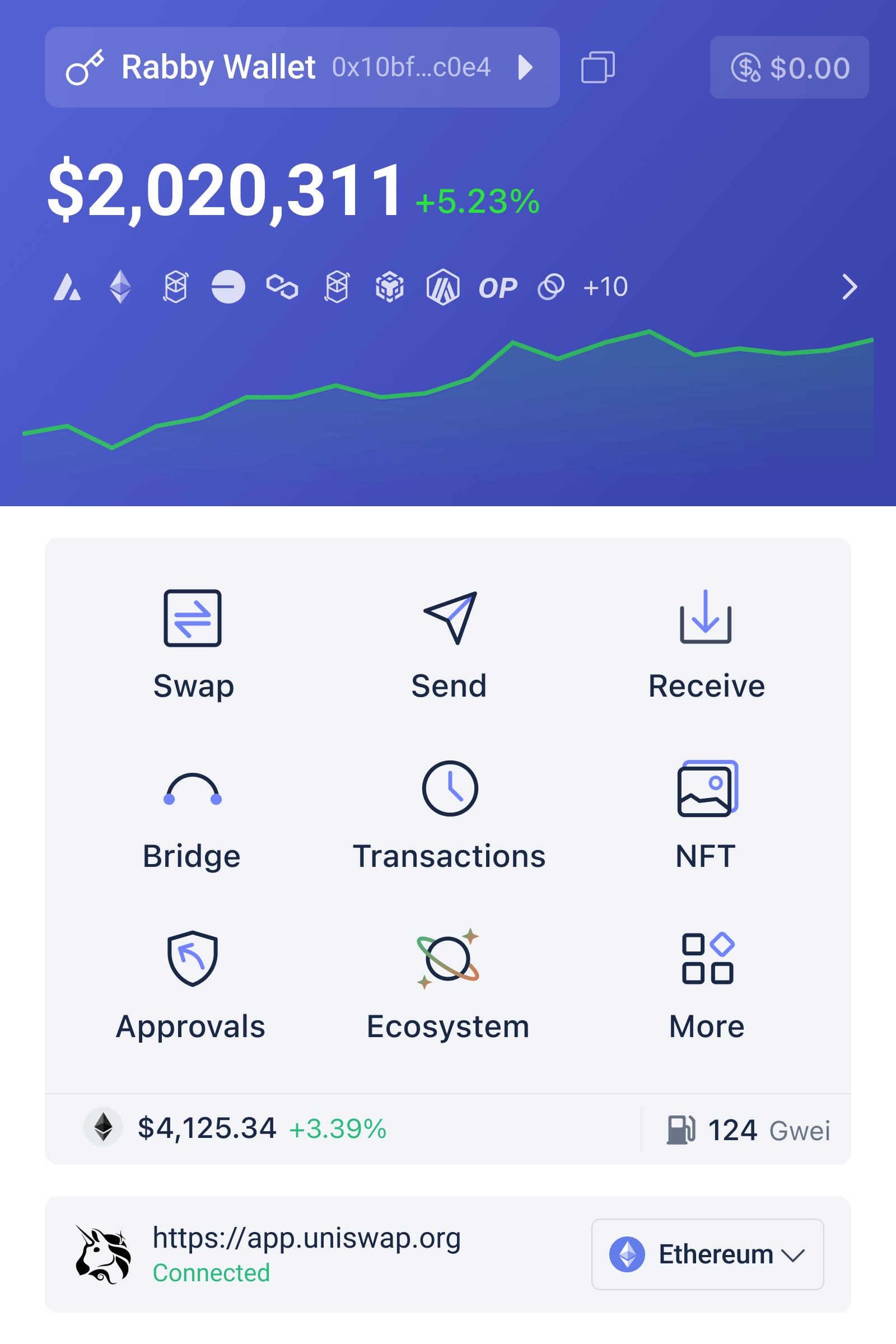
From network switching to transaction understanding
Rabby supports more than 140 EVM-compatible chains and networks, including major ecosystems such as Ethereum, Polygon, Arbitrum, Optimism, Avalanche, Base, and BNB Chain. The practical benefit is not simply a large number on a feature list. EVM compatibility means that many networks use related execution standards, account structures, and smart-contract conventions. A wallet can therefore offer a relatively consistent experience across chains, even though fees, liquidity, bridge risk, and application quality may differ substantially.
Automatic network switching is a small feature with a large behavioural effect. When a decentralised application requests a connection on a particular chain, Rabby can recognise the required network and switch accordingly, reducing manual configuration. This helps prevent one common error: attempting to use the right application with the wrong network selected. Yet automation has a boundary. The correct network is not necessarily the safest or cheapest network, and a familiar application deployed on several chains may interact with different contracts on each one. Automatic switching solves a coordination problem; it does not make the underlying protocol trustworthy.
The more interesting mechanism is transaction simulation. Before signing, Rabby simulates the proposed action and presents expected changes to token balances. In plain terms, the wallet tries to show what the transaction appears likely to do: which assets may leave the account, which may arrive, and which approvals or contract interactions are involved. This is materially better than asking users to decode raw calldata or rely solely on a dApp’s button label.
Simulation should nevertheless be understood as an estimate of execution, not a guarantee of safety. It depends on the state of the relevant blockchain, the quality of the simulation environment, and what the contract actually does when executed. A malicious or highly complex contract may behave differently under conditions the simulation does not fully capture. Market prices can change, liquidity can disappear, and a transaction may fail despite looking reasonable. The correct mental model is not “the wallet has certified this transaction”; it is “the wallet has provided an additional inspection window.” That is a meaningful improvement, but it remains a boundary condition.
Security is a process, not a warning colour
Rabby’s integrated security engine checks contracts and addresses for signals associated with phishing, known compromises, and unlimited token approvals. An approval is permission for a contract to spend a token on the user’s behalf. An “infinite approval” can be convenient because it avoids repeating the permission step, but it can also enlarge the damage if the contract is later exploited or if the user approved the wrong address. Making that risk visible is especially useful for people who interact with lending markets, decentralised exchanges, yield protocols, and bridge interfaces in quick succession.
Warnings are valuable only when users know how to respond to them. A green or unremarkable result does not prove that a protocol is economically sound, solvent, audited to the user’s standard, or resistant to governance abuse. Conversely, a warning may reflect incomplete information rather than a definitive exploit. The disciplined response is to pause, inspect the domain, verify the contract address through an independent trusted channel, review the asset changes, and question whether the transaction is necessary. A wallet can improve judgement, but it cannot outsource judgement completely.
This is where the comparison with MetaMask becomes more useful than a simple “which wallet is better?” debate. Rabby’s differentiating emphasis is the multi-chain DeFi workflow: simulation, richer security signals, automatic network handling, and a transaction view designed around consequences. MetaMask remains widely integrated and familiar. For a user who mostly connects to a small number of established applications, switching wallets may deliver limited practical benefit. For someone who regularly moves across EVM ecosystems, the value proposition is stronger because repeated network and approval decisions create more opportunities for error.
Rabby is also open source and released under the MIT licence, allowing the community to inspect and reuse the software. That improves transparency, but open source is not a synonym for invulnerability. Code review depends on attention, expertise, and the ability to identify problems in a large and changing codebase. Users should treat openness as a condition that supports accountability, not as a security warranty.
Non-custodial control and the operational trade-off
Private keys are stored locally on the user’s device and are not sent to Rabby’s servers. This is the defining advantage of a non-custodial wallet: the user retains control rather than depositing assets with a central intermediary. It also defines the responsibility. If a recovery phrase is exposed, copied into a fake support form, or stored in an insecure location, the wallet provider generally cannot reverse the outcome. Security is distributed to the user, along with the power.
For larger balances or frequent DeFi activity, hardware-wallet compatibility with Ledger, Trezor, and OneKey adds a separate security boundary. The private key can remain isolated from the everyday browser environment while Rabby provides the readable transaction context. This combination is conceptually important: Rabby can be used as an interpretation layer, while the hardware device acts as a signing boundary. Even then, the user must compare the transaction shown on the computer with what the hardware wallet displays where possible. A hardware wallet protects key material; it does not automatically make an unfamiliar contract legitimate.
For readers searching for the Rabby Chrome extension or checking how to install Rabby, the safest principle is simple: begin from the project’s verified distribution channel and confirm the publisher, permissions, and domain before importing or creating an account. A practical installation overview is available here. Never enter a recovery phrase into a website that claims to “activate” an extension, and never treat a search advertisement or unsolicited message as proof of authenticity. In Germany, where users may move between regulated exchanges and self-custody tools, the transition point deserves particular care: withdrawing to the wrong chain or address can be irreversible.
Bridges, swaps, and the hidden cost of convenience
Rabby integrates bridge routes, including LI.FI, so assets can be moved across networks within the wallet experience. It also offers a swap aggregator that scans decentralised exchange venues such as Uniswap and 1inch for routes that may improve price execution and reduce slippage. These integrations compress several steps into one interface. That is convenient, but it can hide the number of systems involved. A cross-chain transfer may involve a source-chain transaction, a bridge mechanism, a destination-chain transaction, liquidity providers, and assumptions about token representations.
The non-obvious risk is interface compression. When many components appear as one clean action, users may underestimate the combined exposure. A bridge route can carry smart-contract, liquidity, validator, relayer, or message-delivery risks that are not equivalent to the risk of a simple swap on one chain. Better routing can improve execution without eliminating those risks. Before confirming, users should ask whether they are swapping, bridging, approving, or doing all three, and whether the received asset is the native asset they expect or a representation issued by another system.
Rabby’s Gas Account feature addresses a different but familiar problem: paying network fees. It can allow users to pay gas across networks with stablecoins such as USDC, even when they do not hold the native token required by a chain. This reduces one of the most frustrating barriers in multi-chain DeFi. It may also make activity feel frictionless enough that users lose track of the separate fee markets and service dependencies involved. Convenience is strongest when it removes avoidable mistakes, not when it removes awareness of what is happening.
Rabby Points, earned through actions such as swaps, gas top-ups, or referrals, add a loyalty and gamification layer. That may encourage exploration, but it introduces a behavioural question: are users performing a transaction because it fits their strategy, or because a reward system makes activity feel profitable? Points should be treated as an uncertain promotional benefit, never as a reason to accept liquidity risk, fees, or smart-contract exposure.
How to evaluate Rabby in practice
A useful decision framework has three tests. First, ask whether the wallet improves visibility: can you understand the expected balance changes, approvals, network, and recipient before signing? Second, ask whether it improves control: are the keys local, is a hardware wallet available, and do you have a tested recovery process? Third, ask whether it changes behaviour for the better: does the interface encourage careful review, or does it simply make complex actions faster?
Rabby is most compelling when the answer to the first test is yes and the user genuinely works across multiple EVM chains. Its simulation, security scanner, network automation, bridge and swap integrations, and broad chain support address real sources of friction. The strongest conditional case for adoption is therefore not that Rabby makes DeFi safe. It is that a wallet with better transaction context may reduce preventable mistakes, particularly when paired with hardware signing and deliberate approval management.
The near-term development to watch is whether multi-chain wallets can keep simplifying access without making risk invisible. Recent project messaging presents Rabby as a general wallet for Ethereum and EVM activity, but breadth creates a maintenance challenge: networks, contracts, token standards, bridge routes, and threat patterns change continuously. The quality of a wallet’s warnings will depend not only on its interface, but also on how quickly its detection and simulation systems reflect that changing environment. Users should judge the tool by observed clarity and reliable habits, not by a single feature announcement.
Frequently asked questions
Is Rabby safer than a traditional browser wallet?
It can provide stronger transaction visibility through simulation, security warnings, and clearer multi-chain context. That does not guarantee safety. Phishing sites, compromised contracts, poor operational security, and user approval remain risks. A hardware wallet and careful verification provide additional protection.
Can Rabby be used without holding every network’s native gas token?
Its Gas Account feature can support paying fees with stablecoins such as USDC across networks, subject to the feature’s availability and conditions. This reduces the need to keep small balances of many native tokens, but users should still understand the fees and service dependencies involved.
Does transaction simulation prove that a DeFi transaction is safe?
No. Simulation shows expected execution and balance changes under particular conditions. It is an important review aid, not an audit, guarantee, or substitute for checking the application, contract address, permissions, and economic risks.
The central lesson is easy to miss. A multi-chain wallet is not secure merely because it supports many chains, and it is not useful merely because it stores keys. Its real value lies in how well it helps users connect intention with execution. Rabby’s strongest contribution is the attempt to make that connection visible before the signature becomes irreversible. For serious DeFi users, that is not a promise of certainty. It is a better place to begin making decisions.